



Inside the Citrus Perfume Trend With Master Perfumer David Chieze
There's a moment every year when the collective mood shifts toward light. When the desire for something fresh, vivid and alive becomes almost visceral. Citrus fragrance has long answered that call, but something different is happening in 2026. This is no longer the territory of simple, fleeting top notes that vanish before you've closed the bottle. Citrus has grown up. It has become layered, complex and deeply intentional, and the industry's most creative perfumers are paying close attention.
At Electimuss London, we have always believed that true luxury lives in contrast: the tension between restraint and boldness, between the ancient and the contemporary. Our newest creation, Amber Bloom, sits at the heart of this evolving citrus conversation, and to understand why, it helps to understand where fragrance is heading.
Citrus Perfume Is Having a Cultural Moment. Here's Why
Citrus fragrance has historically been positioned as a warm-weather default: easy, uplifting, uncomplicated. That perception is changing. Perfumers and houses across the world are discovering what happens when you push citrus into unexpected territory; when you allow it to interact with warmer, darker, more sensuous materials.
The result is a new generation of citrus perfume that feels simultaneously energising and emotionally textured. Fragrances that open with the sharp brightness of grapefruit or mandarin but settle into something far more complex, far more wearable across time and temperature.
This shift is happening for several reasons. Consumers are more fragrance-literate than ever before. They understand olfactive pyramids. They seek out notes, read reviews, and develop genuine connoisseurship. In that context, a one-dimensional citrus simply doesn't hold interest. What does hold interest — what genuinely stops people — is citrus used as a counterforce: a bright, bold opening that earns its depth.
Key Notes Shaping the Modern Citrus Fragrance
Understanding the trend means understanding the building blocks. If you're exploring citrus perfume right now, these are the note territories worth knowing.

The Classics: Grapefruit, Bergamot, Mandarin, Lemon
These remain the backbone of any great citrus composition, and for good reason. Bergamot is perhaps the most refined of the group: green, slightly floral, with an elegance that allows it to bridge citrus and other accords without tension. Grapefruit brings sharpness and bite. Mandarin offers warmth and roundness. Lemon is clean, immediate, and undeniable. Used with skill, these four notes alone can carry an enormous expressive range.

Marine and Sea Salt: The Ocean Accord
One of the most interesting directions in contemporary citrus fragrance is the move toward marine and coastal atmospheres. A marine perfume or sea salt perfume pairs the brightness of citrus with the cool, clean quality of oceanic notes, evoking open water, salt-dried skin, and the sensation of wind. This is not an aquatic fragrance in the 1990s sense. Modern marine citrus compositions are far more nuanced: the salt is mineral rather than synthetic, the marine quality is atmospheric rather than literal. The effect is space and clarity — a Mediterranean perfume sensibility that feels genuinely transportive.

Passionfruit and Raspberry: The Fruity Citrus Evolution
Some of the most compelling citrus compositions of recent years have introduced tropical and berry notes alongside the traditional citrus canon, and the results can be extraordinary. A passionfruit perfume brings a tart, almost acidic vibrancy that complements grapefruit beautifully. Raspberry adds a soft, slightly floral fruitiness that prevents compositions from reading as sharp or cold. Together, these notes create a sense of abundance and warmth without tipping into the saccharine. The key — and this is where perfumer skill becomes everything — is balance.

Warm Citrus Amber: The Note That Changes Everything
If there is one development that has genuinely expanded what citrus perfume can be, it is its relationship with amber. A citrus amber perfume takes the vibrancy of bright top notes and grounds it in something warmer, more sensuous and considerably longer-lasting. Ambergris, tonka bean and musk all play this role in different ways, softening the citrus without extinguishing it, adding what perfumers sometimes call texture. The result is a warm citrus perfume with real presence on skin: one that evolves through the day, reveals itself slowly, and leaves an impression long after the opening has settled.
In Conversation: Master Perfumer David Chieze on Amber Bloom
To understand Amber Bloom, the first fragrance in the Auras collection, we went directly to its creator. Master Perfumer David Chieze is no stranger to complexity; his work is defined by a commitment to contrast, beauty and emotional truth in scent. We asked him about the thinking behind this new Extrait de Parfum.

What was your guiding inspiration for this fragrance?
"Inspiration is primarily drawn from nature — particularly concepts such as balance, contrast, duality and beauty."
That framing is evident in every layer of Amber Bloom. This is a fragrance built on productive tension: the brilliance of exotic fruits held in check by woody depth and the unexpected coolness of salt. Nothing here is straightforward.
Can you describe Amber Bloom in three words?
"Bold, colourful, textured."
Three words that, unusually for a fragrance description, actually do the work. Amber Bloom is not subtle in its ambition, but it earns its boldness through craft.
Walk us through the creative process.
"The fragrance began with an intentional overdose of passion fruit and tangerine. To counterbalance the vibrancy of these fruity notes, woody and salty elements were incorporated, creating contrast while keeping the composition expressive but not overly sweet."
The word intentional matters here. This is not excess for its own sake. The overdose of passionfruit and tangerine is a creative choice with a purpose: to establish something vivid enough that the base materials have something genuinely worth grounding.
Is there a note that might surprise people?
"Perhaps aldron. It's ambery, milky, woody and animalic. Some part of the population doesn't perceive it. Its molecular structure could be close to that of sexual hormones, contributing to an erotic feeling."
Aldron is not a note you encounter in most mainstream fragrance conversations, which makes its presence in Amber Bloom quietly radical. It is, in the most literal sense, a note that works on you without your full awareness: a subliminal warmth that contributes to the fragrance's unusual intimacy.
What emotions should the wearer expect?
"The fragrance is intended to make the wearer feel energised, happy and confident."
A deceptively simple answer from a perfumer whose work is anything but simple. Amber Bloom is, at its core, a fragrance about joy — but it is complex, assured joy. Not girlish or gauzy. Something bolder, more grounded.
Amber Bloom by Electimuss London
Amber Bloom opens with a dazzling citrus accord — lemon, grapefruit, mandarin and bergamot arriving together with an immediacy that is almost overwhelming in the best possible sense. This is not a gentle introduction. It is vivid and declarative.
From there, the heart unfolds with lily of the valley lending a brief, cool floralcy before the fragrance's more distinctive character emerges: raspberry and passionfruit in that intentionally heightened concentration David describes, alongside sea salt notes that add a mineral freshness and a quiet, coastal restraint. It is at this stage that Amber Bloom begins to diverge from any straightforward citrus fruity composition. The salt lifts everything. It keeps the fruit from feeling indulgent, giving the composition the quality of warm skin rather than sweetness.
The base is where the fragrance truly reveals itself. Ambergris, tonka bean and musk settle into a quietly luxurious warmth, the signature of a warm citrus amber perfume that wears beautifully close to the skin and lingers with genuine elegance. The aldron, imperceptible to some, adds that final layer of intimacy: something you feel as much as smell.
As a high-concentration Extrait de Parfum, Amber Bloom delivers all of this with the kind of depth and longevity that lighter formulations simply cannot achieve. It is a summer fragrance, yes. But it is a summer fragrance built to last.
The Notes at a Glance
Top: Lemon, Grapefruit, Mandarin, Bergamot
Heart: Lily of the Valley, Salt Notes, Raspberry, Passionfruit
Base: Ambergris, Tonka Bean, Musk
Why Summer Calls for Citrus — and Why Amber Bloom Answers
Summer fragrance is often treated as a category of compromise: something light and inoffensive that won't overwhelm in the heat. Amber Bloom rejects that premise entirely. Heat, in fact, is where it comes alive. Warmth amplifies its fruit, draws out its salt, deepens its amber base. It is a fragrance that wears the season rather than hiding from it.
This is, ultimately, what the best modern citrus perfume does. It doesn't defer to summer; it inhabits it. It brings energy without fragility, brightness without ephemerality, and a sense of self-assurance that carries from morning into evening without apology.
Amber Bloom is available exclusively as an Extrait de Parfum, because here at Electimuss, we believe there is only one concentration worth working in.
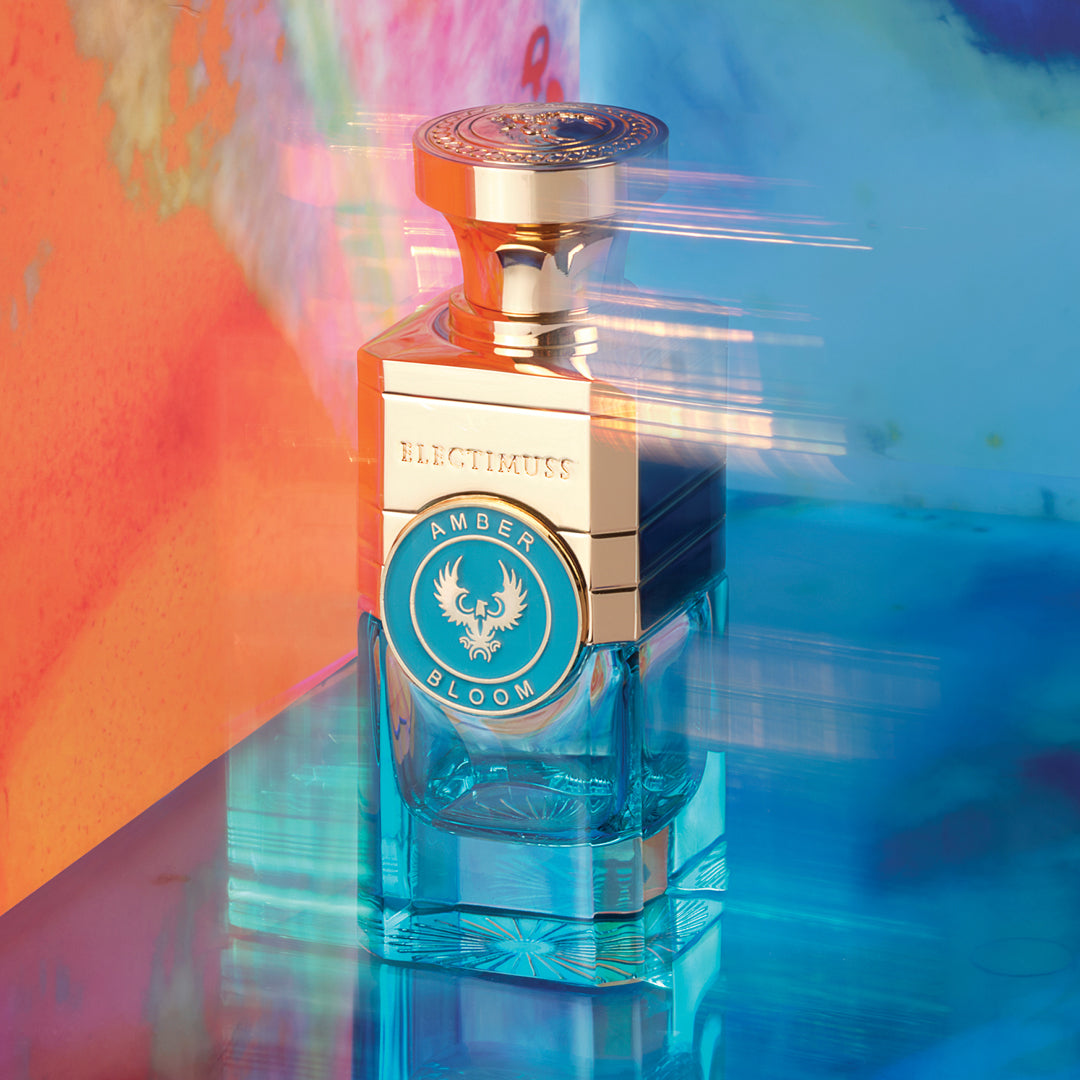
Amber Bloom
The first fragrance in the Auras collection. A vivid citrus accord grounded in warm amber and sea salt — an Extrait de Parfum built to wear the season.